
Rollup, Granollup
Does Granola win by winning on meeting notes? Whither Granola? And WTF are workflows worth?

I like the meeting note-taking app ‘Granola’. If you have not used Granola, it transcribes your calls and writes summaries of them. You can chat to your meeting notes, and it sorts them into folders. It solves the problem of “who was it that told me about x?” or “what was this client’s reason for buying our competitor?”
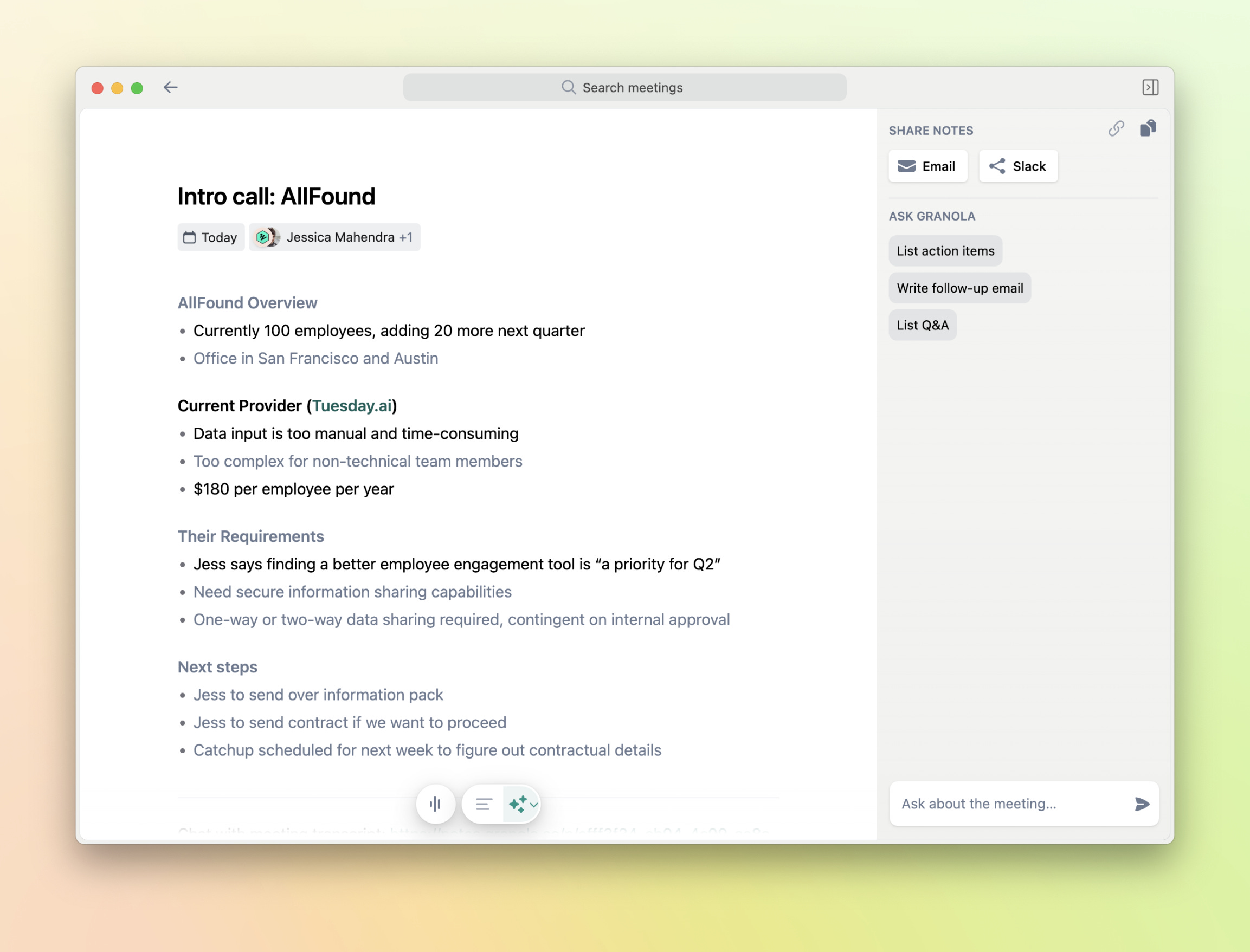
I don’t know the guys who started it, but I like that they’ve quietly taken over the world of meeting notes from an office in East London, without relying on much pizazz or a fancy Twitter launch video. They recently rebranded to a less good logo and less nice colour scheme for reasons that are not clear to me, but that’s ok! The product remains really good.
I like Granola for two reasons:
Firstly it’s better than other solutions, because it is lightweight and simple. It doesn’t make full recordings that clog my CPU or squat in meetings as an AI participant taking up a chunk of screen real estate. It just listens in on my PC, and writes a little summary and lets me search for specific things across meetings and saves me scribbling or tapping during the call. You can also write things in its notepad while it’s making its own notes. It gets the job done.
Secondly, it’s an AI era anti-pattern. I mean, starting a notetaking app? That wraps around third-party transcription models? In 2024? Are you MAD?!
The most repetitive part of raising money from venture capitalists is when they ask about competition. If there isn’t any competition, you’re in a tiny market (true), and if there is any competition, you’re in a busy market (also true). The emergent VC worldview is they will pick a company in an emerging-busy category, and by putting money into it will kingmake that startup. There’s an eerily neocolonial vibe to it, but if it’s a suitable outlet for VC main character energy, so be it. Let them make some of us paupers into kings.
Anyway, notetaking really is a busy market. Think of all the competitor note taking and meeting note tools VCs can name in your Zoom call: Evernote owned it then f*cked it, Google apparently do it, Microsoft did it ages ago, Dropbox tried it, ChatGPT does it, Notion now does it, specialised AI note takers do it…oh and Anthropic will kiss you softly, then eat you alive and suck on the bones. And maybe record that.
What I like a lot about Granola is they had the chutzpah to say “busy market? Hold my beer”. They popped a nice wrapper around a transcription model built by AssemblyAI (I think), added a RAG-driven LLM chat and some very helpful ‘slash command’ tooling that lets you nerd out in fun ways on your notes, then pitched it to VCs in a brilliant customer acquisition amplification play. And by doing so became worth $250mn for a free product. Chef’s kiss. When they recently announced they would begin charging us, I felt the way I felt when I bought a subscription to Bear, or to Ordnance Survey, or Strava: I don’t need to pay for this. I could use something else. I do get this functionality free some other way. But it’s better enough that I will pay for it.
The takeaway here is that it’s a really good idea to see a problem, solve that problem in the simplest and most beautiful way you can, ignore the chatter and let rip. My data-slash-blogging superhero Benn Stancil recently covered this idea in his post “The best is still hard to be”:
But once everyone has a [software] factory, then what? Having one will no longer be a competitive advantage; everyone’s CRM will be a chatbot and on top of a spreadsheet. Then, inevitably, someone—maybe Salesforce! Maybe some former Salesforce employees!—will spend a bunch of time on the small details of that chatbot and that spreadsheet, and they will make the best one. And we’ll all decide that we’re unsatisfied with everything else, that that’s our new standard, and actually, now, we have some complaints and want something even better. Sure, success may be on the far side of a threshold—but that threshold is not static.
I think I agree, but Benn fails to mention something that plays into this: how many points of pain are involved in replacing the current thing? Salesforce will be ok for quite a while because changing your CRM doesn’t mean migrating data. It does, but data migration is relatively easy. It’s like chewing glass in terms of fun levels, but the glass is not as sharp as replacing integrations. Like any grown-up system of record, Salesforce is a beating heart. It has hundreds of veins and arteries. You can do heart replacements, but do you want to? Do you have the time, the energy, the pathological intensity of a heart surgeon? Is changing the CRM going to be the thing that makes your beer taste better, to ape a great Bezos line?
Granola proves Benn’s point. Granola spent a bunch of time on the small details around meeting notes. It has become the current new standard for them. But Granola could do that because it provides a flow of blood through one small vein. I can swap my meeting recorder in 5 minutes. As a result, Granola is worried that someone will make a new standard for recording my calls. Because Granola is not the beating heart of my company, it will be hotswapped like an F1 tyre the second some new meeting-fatigued founder comes along with a free, even cooler meeting note maker. So what are they doing about it?
WTF are workflows?
I recently went to a meetup where a Granola team member (Granol-er?) mentioned they would start to extend Granola. Granola does not like this little box we’ve put it in. It wishes to be a king, not a middle-class, former pauper! First they added an MCP so we could talk to our notes in Claude Code. Next they will add “post-meeting workflows”. But WTF are workflows?
Post-meeting workflows are part of the sludge of work that a smart marketer at Clay named “GTM engineering”, to make system admins sound more hip. I used to be a photography forum admin in the noughties, but I now realise I was a discourse engineer, and feel much better about myself. Anyway, after a sales call, you need to do lots of stuff: update the CRM, make some new slides, email the client, send feedback to the product team. Each of these tasks is boring. Great sales people like talking to prospects, not updating Hubspot or Salesforce. Busy founders like high-leverage and focus, not sending follow-up emails or editing Google slides for each deal.
A lot / of / people / want / to / own your go-to-market workflows. Lindy helps you get 2hrs a day back. Monaco does GTM end-to-end. Notion agents turn notes into tasks. Zapier sends all the data to all the places, but now with LLMs in there. n8n lets you do Zapier stuff, but on dark mode, and with more python so you sound smart at meetups. The list goes on. Gong, Fathom, Clari, heck, even Calendly tells me it does workflows after my meetings.
It makes sense then that Granola wants to add workflows. They already own the inflow: they record the call. So, they stand a much better chance at workflow-ing my calls than Zapier do: that’s yet another integration. I could use their MCP in Claude Code and do my GTM workflow in the CLI, and my tweet about it could go viral, but normal people don’t want to do that! Normal people like going home and walking the dog and playing with the kids, not tapping cd ../../.. ls into a black screen. If my Granola notes start to appear in my CRM and start to write the follow up email and draft it in my mailbox, that’s cool!
Be the heart, not the blood
I hope it works for Granola. I bet they’ll make lovely workflows. They are demonstrably good at making good things. But I think it’s missing the big opportunity. It’s a wonderful inflow of information into my system of record, but it is not itself a system of record. It is not the database of deals, it is the appended ‘note’ field on the deal record in that database.
The system of record into which Granola workflows my notes is the heart that they should build. Without naming any names, I have tried the latest-greatest AI-first CRMs out there, and they do not feel much different to Hubspot. They are good, but not great products, built by business people, but not by the sort of product designers Benn’s piece holds in highest regard the people who raise the bar.
This leaves me in a weird position: I like Granola 9/10, but would swap it out in 5 minutes. I feel 3/10 about my CRM, but a few months into building my new startup Rig, it already has a few veins and arteries going in and out, and I’d rather walk over hot coals than have to re-do all that work. In my bleary state after setting it all up, they pitched me an annual subscription with a discount, and I screamed into my pillow then paid them the money. It was good enough.
But Granola are bar-raisers. And we are seeing a Cambrian explosion of new companies being born. It is a wonderful time to be the new standard in a category, and a wonderful time to be a system of record. In this sludge of “GTM”, a slew of new veins is arriving and being swapped out constantly. Apollo finds me prospects. Clay finds me prospects and writes summaries of their Linkedin. Granola records my calls with them, but so does Gong. All of these tools produce blood, and I need to send it into my heart, my CRM, my sweet source of truth and life. And when that new, cool call recorder arrives, and it to adds my CRM integration, I can swap that vein over right away.
To horribly butcher Blaise Pascal, there’s a heart-shaped hole in every startup. It’s the CRM. And the war there is not won. The worst part about CRMs is populating them with the right data. Granola already owns a big slice of that. I will try Granola workflows to populate my CRM or whatever else they’ll do, but I would rather skip workflows, avoid any GTM engineering, and let everything live in the Granola CRM. I think they can set the new standard.
Finally, on the topic if granola - if you have reached the end, and like the foodstuff, my friend Chloe makes Britain’s finest (food) granola, which is also artisanal and sets a new standard. Give it a try!